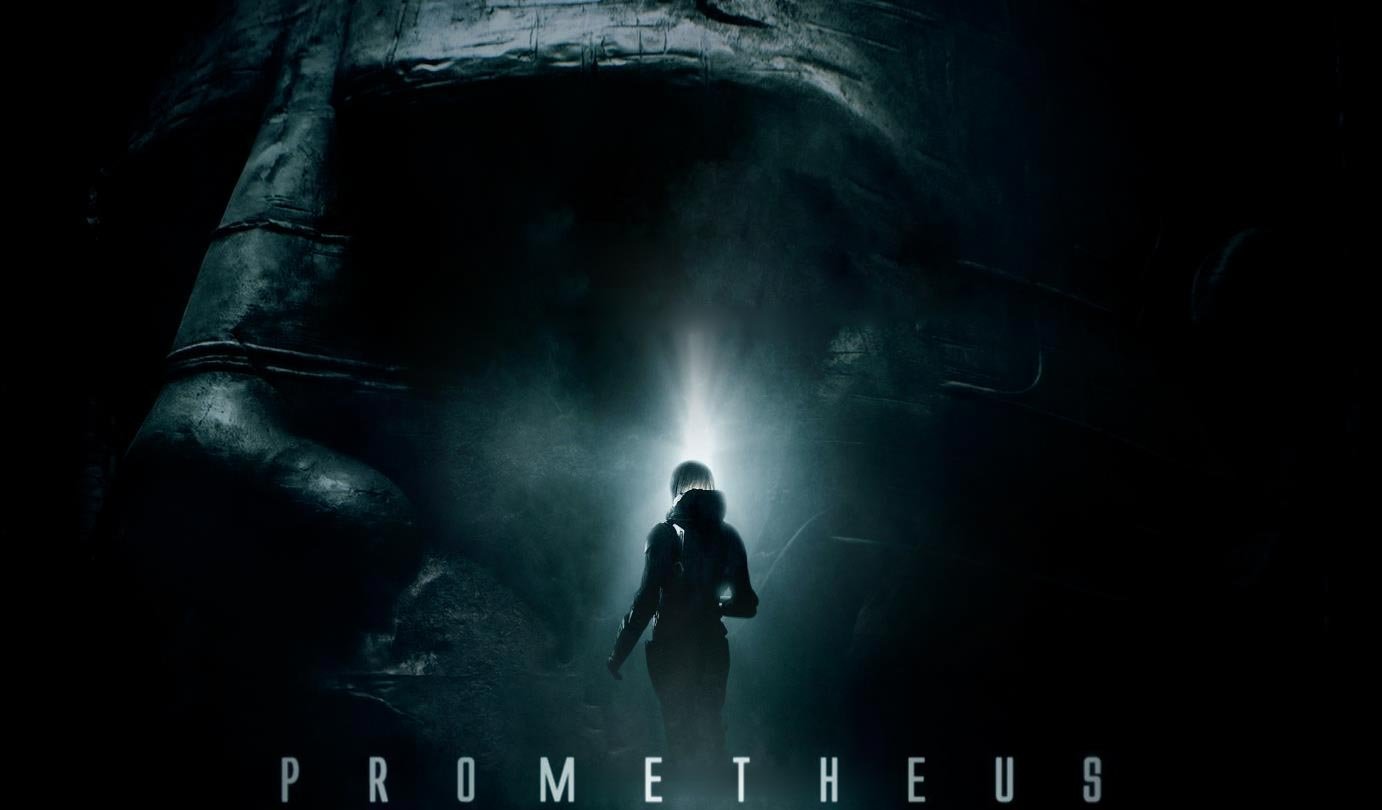
Meredith Vickers walks onto the Prometheus bridge like she already read the ending and decided not to share. Charlize Theron plays her with a spine so straight it reads as architecture—corporate ice without camp, without the villain monologue that would let you feel superior. Vickers is what happens when Weyland Industries sends a person instead of a memo. Theron’s job is to make you feel the memo anyway: this mission is ego dressed as science, and somebody has to keep the receipts. She is not the hero. She is the adult in a room full of expensive children pretending adulthood is a helmet cam.
The casting choice lands because Theron can do frost without emptiness. Watch her eyes in the hologram briefing when Holloway and Shaw sell star maps like lottery tickets. She is not bored. She is calculating how much liability is accumulating per minute of enthusiasm. That calculation is a performance genre blockbuster cinema forgot how to write: competence without charm, authority without explanation. For beat-by-beat plot function, the Meredith Vickers guide covers the basics. This essay is about why Theron makes Vickers feel like a person who could run a company, not a screenplay’s idea of one.
Hierarchy on a ship that pretends to be a family
Prometheus is obsessed with pecking order—Weyland’s ghost budget, Janek’s deck, Shaw’s moral claim, David’s quiet sabotage. Vickers sits at the intersection where money becomes command. Theron plays rank as posture: where she stands, who she touches, who she refuses to look at. When she tells Shaw they are not friends, the line is blunt on purpose. Bluntness is kindness compared to the faux camaraderie corporate expeditions sell in recruitment videos.
Costume and insignia do half the work; Theron does the other half. She moves through corridors like someone who knows which doors lock from her side. The film’s costume and insignia essay talks about quiet propaganda on the ship. Vickers is the propaganda made flesh—logo thinking in a human suit. Theron never winks at the audience to say “real villain here.” She plays Vickers as a true believer in containment: if the mission goes wrong, someone must survive to tell the stockholders it was not negligence. That belief is colder than malice. Malice sweats. Vickers does not.
Her relationship to Weyland is sketched in fragments—daughter, heir, rejected successor, person who built a life raft in the captain’s quarters. Theron loads those fragments into pauses. When Pearce’s Weyland finally appears, Vickers’s face is not surprise. It is confirmation of a worst-case scenario she rehearsed. You do not need a twenty-minute backstory monologue when an actor can say “I knew you would cheat death and take us all with you” with a jaw muscle. The Peter Weyland guide handles the myth. Theron handles the family wound in glances.
Sex, power, and the flamethrower turn
The Janek-Vickers flirtation is divisive. I think it works because Theron and Idris Elba play it as two professionals testing whether warmth is allowed on a doomed contract. It is not gratuitous softness. It is human scale—brief proof that Vickers is not only a glass statue. When Janek asks if she is a robot, the joke lands because Theron has been playing her that precisely. The robot question is intimacy disguised as banter. Both actors know it. Both refuse to oversell it. That restraint keeps the ship believable as a workplace where people still reach for each other before the biology turns feral.
Then the storm, the Juggernaut rolling, and Vickers running for her life. Theron’s sprint is not action-hero poetry. It is panic with dignity falling off in strips. The falling ship sequence is chaos cinema done with spatial clarity; Vickers’s death is ugly and unheroic on purpose. Theron makes sure you feel the insult of it—this person who saw the trap clearly dies because physics does not care about org charts. The flamethrower scene guide documents the beat. Theron’s earlier work sells why that beat matters: Vickers tried to cauterize a problem the mission refused to name until it was too large to burn.
Some viewers want Vickers punished for being cold. The film punishes her for being right without being listened to. Theron threads that needle. Vickers is not Shaw’s sister in solidarity. She is the woman who tells Shaw the truth about corporate ownership of the expedition and gets hated for tone. Tone is how power tells you to sit down. Shaw keeps standing. Vickers keeps counting exits. Both are survival strategies. Only one gets called brave in fan essays. Theron makes you reconsider the other.
Corporate ice as moral weather, not cartoon evil
Blockbuster villains often perform evil so the audience can feel clean. Vickers performs liability management in a universe where creation is violent and CEOs buy immortality like a software upgrade. Theron refuses the cartoon. When she says “a king has his reign,” she is not quoting poetry for style points. She is describing Weyland’s delusion with the flat voice of someone who has seen the balance sheet of gods. The line lands because Theron treats it as reportage, not villain speech.
Compare her to Michael Fassbender’s David in the casting essay. David empties rooms with stillness that feels alien. Vickers empties rooms with stillness that feels corporate—both are predatory, but the predation rhymes differently. David is curiosity without conscience. Vickers is conscience without illusion. Theron makes illusion-free leadership look like loneliness. That loneliness humanizes a character the script could have made a punchline.
On rewatch, watch Vickers in scenes where she is not speaking. Theron keeps Vickers thinking on camera. Eyes track David like a hazard label. Shoulders tighten when Shaw invokes faith as mission justification. Fingers on glass in the lifeboat—touching the escape she built because she trusted her father’s hubris to outlive prudence. Every silent beat says the same thing: I told you so, and telling you so will not save me. That is tragedy in a minor key, played by an actor who knows minor keys are how real companies fail in public while smiling for shareholders.
I will not pretend Vickers is the secret protagonist. She is not. She is the film’s clearest statement about who owns risk on missions like this—and who pays when ownership hides behind theology and star maps. Charlize Theron’s performance makes that statement land in the body, not only in the Weyland Corporation guide. Corporate ice, in her hands, is not a aesthetic. It is weather you have to walk through to get to the pyramid. The weather kills you before the monsters bother. Theron makes you feel the cold early, so the later heat reads as consequence, not surprise.
Rewatch her first scene with David after the storm—how little she trusts him, how much she needs him anyway. Theron is not in the frame, but Vickers’s policies put Shaw in that dependency. Corporate ice upstream becomes human desperation downstream. Theron’s performance makes the upstream visible even when she is absent. That is star work in a supporting architecture role: shaping scenes you are not in by establishing rules your absence enforces. Vickers would call that good management. The movie calls it fate with a Pilates posture.
Theron also makes Vickers funny in the driest possible register—not jokes, but the humor of watching someone who has already done the risk assessment while everyone else is still pitching wonder. That humor is easy to miss because it is not written as quips. It is written as posture. Posture comedy is elite comedy. Blockbusters rarely allow it for women without softening them into sidekick energy. Vickers never becomes a sidekick. She becomes ash. Ash is not a punchline. It is a receipt.